Forty Years Ago

It was the summer of 1979 and I had just finished my first year of teaching high school math for the Alamogordo Public Schools. Ruth was almost 3 and Mike was 1-1/2. We had an old beat up station wagon that we hoped would make the 1700 mile trip from New Mexico to the family farm in Michigan. I hadn’t been back to see my folks since before the kids were born. Spending summer on the farm would be a wonderful experience for everyone.

Now here I am 40 years later driving once again from New Mexico to Michigan. All these hours in the car today have given me lots of time to reminisce and reflect on the paths life has taken. Who would have imagined 40 years ago that the 1-1/2 year old kid going to his grandparents farm then would today be a seasoned long haul truck driver who just happened to have a route crossing ours as we went through Oklahoma?

Mike was taking a load from Dallas to St. James, Missouri, traveling north on Highway 69. We had spent the night just east of Oklahoma City and would be traveling east on Interstate 40, passing by St. James later in the day. By Mike’s calculation we could meet up at Big Cabin, OK, where the highways come together. I think he had to squeeze his schedule a bit and get an extra early start, but, amazingly enough it all came together and Lee and I were there just a few minutes before that good-looking Celadon truck turned the corner into the travel plaza.

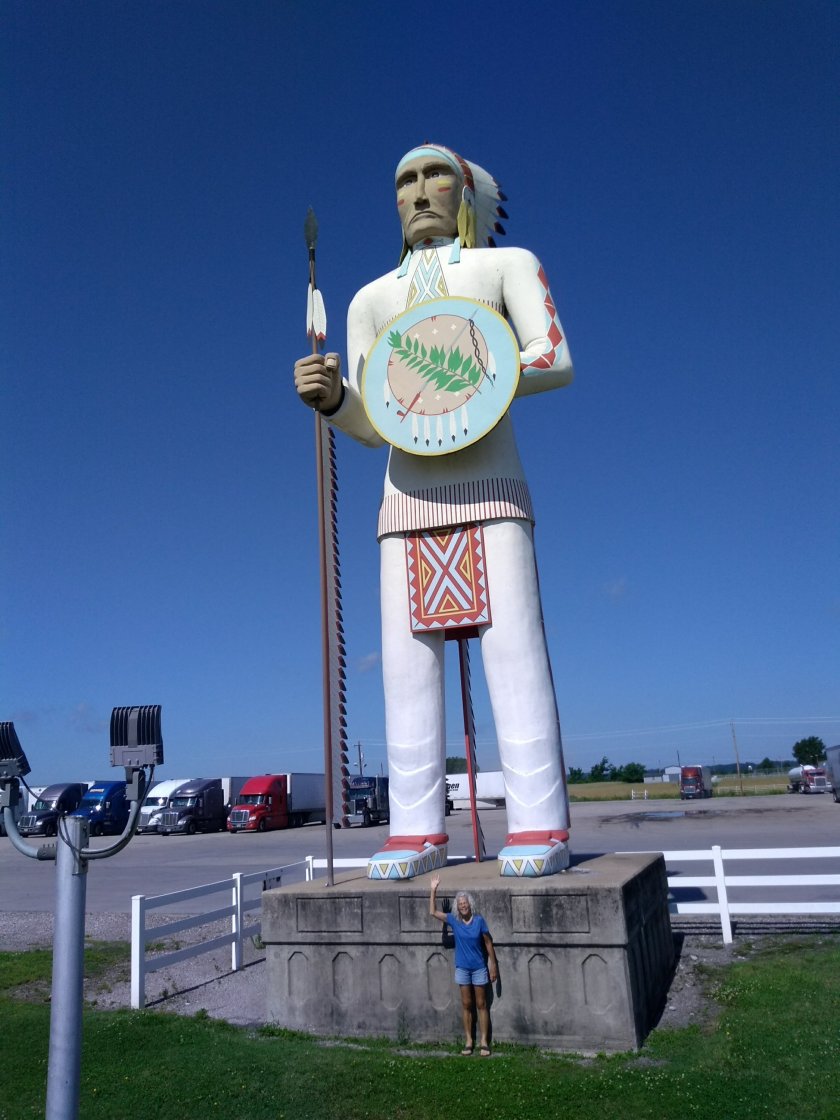
Mike with his usual busy schedule didn’t have much time to spare. But this was an interesting spot that he picked for our meet up. The travel plaza features a 50-foot statue of an Indian Chief. After all, the highway is going through the Cherokee Nation. The statue wouldn’t have been here in the days I traveled the route so I appreciated the chance for the close-up view. He’s so big that I’m barely visible in the photo!

Here’s the story of the statue, if you’re interested.

If you’re interested in the rest of the story of taking the old station wagon on that long trip (or some of the other years taking those trips to Michigan) you’ll have to wait until another day when I get motivated to work some more on my “memoir.”

Mesa Penistaja

After viewing hundreds of photos last night from Mike Richie’s “San Juan Basin Badlands” presentation at the Native Plant Society meeting, it was obvious that today’s hike should be an exploration of one of the areas discussed in the presentation. Shortly after moving to Albuquerque, I went on a hike with the hiking club to Ceja Pelon, one of the 5 Nacimiento Badlands west of Cuba. Lee and I have considered exploring out there before on our own but without any established trails we didn’t know if we should attempt it.

Just recently, however, I discovered a phone app that allows me to load a GPX track on to a map and then follow the track–exactly the functionality that a handheld GPS device provides but no need for an extra gadget. The hiking club publishes their GPX tracks on their website so now we can use their tracks to guide us to new destinations.

For today’s hike we selected Mesa Penistaja, a 6.6-mile loop hike that promised interesting rock formations and lots of petrified wood. It certainly delivered on the petrified wood. Pieces of all shapes, sizes and colors were scattered throughout the arroyos and on top of the hillsides. The dominant flower in the grassy areas was the Mariposa Lily. I have never seen them in such abundance. Many were growing together in clusters, whereas usually they are just a single isolated plant.

The GPX track gave us a place to start the hike and a reassurance that we could find our way back through the maze of arroyos. We ended up only doing about half of the published hike before we veered off and created our own track. With so many things to look at we weren’t hiking very fast and, given how hot it was, we felt that 5 miles was enough to call it a day.

1

2

3

4

5

6
Ponderosa Pine grow on the mesa tops.
7
And some of them are fighting for their lives!
8
Detail in petrified wood.
9
A pile of petrified wood.
10
Bleached white petrified wood in arroyo bottom.
11
Looks like a regular log, but it’s petrified.
12
A chunk of petrified wood that got left on top of eroded mud.
13
Petrified log next to a dead branch.
14
Close-up of Mariposa Lily.
15
Cluster of Mariposa Lily.

16

17